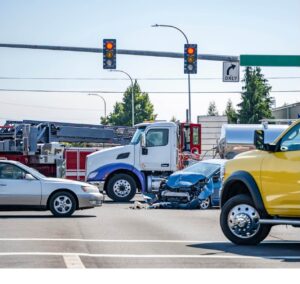

Are Trucking Companies Liable for Driver Negligence in Washington?
Yes. A trucking company may be legally responsible for a commercial driver’s negligence in Washington, particularly when the driver was acting within the scope of their employment when the crash occurred.
A trucking company may also face liability for its own negligent decisions, such as hiring or retaining an unsafe driver, failing to properly supervise drivers, ignoring safety violations, creating unsafe delivery schedules, or failing to inspect and maintain commercial vehicles.
That distinction matters after a serious truck accident.
A crash may appear to have been caused entirely by a driver’s speeding, fatigue, distraction, or unsafe lane change. But an investigation may reveal that decisions made by the trucking company helped create the conditions that led to the collision.
In a serious Washington truck accident, the investigation should therefore examine both:
- What the truck driver did, and
- What the trucking company knew, required, permitted, or failed to do before the crash.
When Is a Trucking Company Responsible for Its Driver's Negligence?
There are generally two different ways the conduct of a trucking company may become important after a crash.
1. Vicarious Liability for the Driver’s Negligence
Washington recognizes the doctrine commonly known as respondeat superior.
Generally, an employer can be held vicariously liable for a tort committed by an employee while the employee is acting within the scope of employment.
In a commercial trucking case, that could mean a motor carrier is responsible when its employee causes a collision while performing work for the company, such as transporting freight or carrying out assigned driving duties.
For example, a commercial driver may cause a crash by:
- speeding;
- following too closely;
- making an unsafe lane change;
- driving while distracted;
- failing to yield;
- driving while fatigued;
- failing to properly inspect the truck; or
- operating the vehicle unsafely in rain, traffic, construction, or other road conditions.
If the driver was performing work for the trucking company when that negligence occurred, the company may also face responsibility.
2. Direct Liability for the Trucking Company’s Own Negligence
A separate question is whether the trucking company itself made unsafe decisions.
Depending on the circumstances, an investigation may examine whether the company was negligent in areas such as:
- hiring;
- retention;
- driver qualification;
- supervision;
- training;
- dispatch;
- hours-of-service monitoring;
- vehicle inspection;
- maintenance;
- repair;
- safety enforcement; or
- responding to known problems with a driver or vehicle.
This type of claim focuses on what the company did or failed to do, rather than simply making the company answer for the driver’s negligence.
That distinction became especially important under a recent Washington Supreme Court decision.
Washington Supreme Court: Employer Negligence and Driver Negligence Can Be Separate Issues
On September 3, 2026, the Washington Supreme Court decided Earl v. Campbell, No. 104495-0.
Although Earl did not involve a commercial trucking accident, the case addresses an important Washington employer-liability principle.
The Court held that vicarious liability and negligent retention are separate and distinct causes of action that can be maintained in the same case, particularly when the claims concern different negligent acts.
In other words, the fact that an employer may be responsible for what an employee did does not necessarily eliminate a separate investigation into what the employer itself did.
The Court explained that negligent retention focuses on whether an employer retained someone despite knowing the employee was unfit, or whether information reasonably available to the employer would have revealed that unfitness.
That principle can be particularly significant in commercial trucking cases.
If a truck driver causes a serious collision, the investigation should not necessarily end with the question:
Was the driver negligent?
It may also need to ask:
What did the trucking company know about that driver before the crash?
What if the Driver Violated the Trucking Company's Rules?
A trucking company cannot necessarily avoid responsibility simply by arguing that its driver violated company policy.
Washington courts have recognized that an employee’s violation of a workplace rule does not automatically place the employee outside the scope of employment.
That can matter when a trucking company argues:
- “The driver wasn’t supposed to speed.”
- “Our policy prohibited distracted driving.”
- “The driver was told not to exceed their available hours.”
- “The driver violated our safety manual.”
- “The driver acted against company instructions.”
The existence of a written policy is relevant, but it does not by itself answer the liability question.
An investigation may need to determine whether the policy was actually enforced.
For example:
Did supervisors review driver behavior?
Were violations disciplined?
Did dispatchers know the driver was running out of legal driving time?
Did management tolerate similar conduct in the past?
Were drivers rewarded for delivery times that were difficult to meet safely?
Did company practice match the written safety policy?
A company can have an impressive safety manual and still operate unsafely in practice.
How Can Negligent Hiring Make a Trucking Company Liable?
Commercial trucking companies are expected to determine whether drivers are qualified to safely operate commercial vehicles.
Federal Motor Carrier Safety Administration regulations require covered motor carriers to maintain driver qualification records and investigate certain aspects of a driver’s history.
Depending on the driver and applicable rules, those records may include information concerning:
- employment applications;
- commercial driver’s licenses;
- motor vehicle records;
- previous employment;
- prior safety performance;
- crashes;
- traffic violations;
- medical qualifications;
- road testing; and
- periodic review of driving records.
FMCSA regulations require motor carriers to investigate and document certain prior employment safety information for drivers. Driver qualification files are also governed by federal recordkeeping requirements, including 49 CFR Part 391.
That can make the driver’s history critical evidence after a catastrophic truck crash.
Warning Signs That May Matter
An investigation may look for evidence of:
- previous preventable crashes;
- repeated speeding citations;
- reckless driving violations;
- license suspensions;
- hours-of-service problems;
- positive drug or alcohol tests;
- failed inspections;
- prior employment safety concerns;
- inadequate commercial driving experience; or
- medical issues affecting the driver’s ability to safely operate a truck.
The existence of a prior violation does not automatically prove that a carrier negligently hired the driver.
The more important questions are what information was available, what the company actually knew or reasonably should have discovered, and whether that information revealed a foreseeable safety risk connected to the eventual crash.
Can a Trucking Company Be Liable for Keeping an Unsafe Driver?
Potentially.
Problems may emerge after a driver has already been hired.
A trucking company may receive information showing that a driver is becoming unsafe, such as:
- repeated crashes;
- speeding events;
- hours-of-service violations;
- failed roadside inspections;
- complaints;
- unsafe driving reports;
- drug or alcohol concerns;
- license problems;
- disciplinary issues; or
- repeated violations of company safety policies.
This is where negligent retention can become important.
The September 2026 Washington Supreme Court decision in Earl v. Campbell explains that negligent retention concerns an employer’s own conduct in continuing to employ someone despite known or reasonably discoverable evidence of unfitness.
In a trucking case, that may make the company’s records just as important as the police collision report.
What Records Can Show That a Trucking Company Was Negligent?
A serious commercial truck accident investigation may require evidence that is not available at the crash scene.
Some of the most important records are controlled by the trucking company itself.
Driver Qualification Files
A driver’s qualification file may provide information about:
- employment history;
- driving history;
- motor vehicle records;
- prior employer safety information;
- licensing;
- qualification reviews; and
- other federally required documentation.
These records can help answer whether the company appropriately investigated the driver before putting that person behind the wheel.
Driving Records
Motor vehicle records may reveal:
- speeding violations;
- reckless driving;
- license suspensions;
- previous commercial vehicle violations; and
- other driving history.
A single ticket does not establish negligent hiring or retention.
Patterns can matter.
An experienced trucking investigation looks at the driver’s record together with what the company knew, when it knew it, and how it responded.
Electronic Logging Device Records
Electronic logging devices, often called ELDs, can provide information about a driver’s hours of service.
Federal rules restrict how long many commercial truck drivers can drive and remain on duty.
For many property-carrying drivers subject to the federal regulations, the rules generally permit up to 11 hours of driving after 10 consecutive hours off duty and prohibit driving beyond the 14th consecutive hour after coming on duty, subject to applicable exceptions.
When fatigue is suspected, an investigation may compare:
- ELD records;
- dispatch instructions;
- GPS data;
- fuel receipts;
- toll records;
- pickup and delivery times;
- electronic communications; and
- other records showing the driver’s actual movements.
Learn more about truck accident evidence including black box data, electronic logs, and other records.
Dispatch Communications
Dispatch records can reveal what was happening inside the trucking operation before the collision.
Relevant evidence may include:
- text messages;
- emails;
- dispatch software;
- load assignments;
- delivery deadlines;
- GPS messages;
- warnings from the driver; and
- communications concerning available driving hours.
For example, a driver’s fatigue may initially look like an individual mistake.
But dispatch records could show that company employees knew the driver had little legal driving time remaining and continued pressuring the driver to make the delivery.
That would create a much broader liability investigation.
Can a Trucking Company Be Responsible for Driver Fatigue?
Potentially.
Driver fatigue is one of the most important issues in serious commercial trucking cases because the cause may extend beyond the driver’s personal decision to stay behind the wheel.
Federal hours-of-service rules are intended to limit excessive commercial driving.
When a fatigued driver causes a collision, the investigation may ask:
- How long had the driver been working?
- How long had the driver been driving?
- Was the electronic log accurate?
- Were required breaks taken?
- Did dispatch know how many hours remained?
- Was the driver instructed to continue?
- Was the delivery deadline realistic?
- Were log violations previously identified?
- Did the company routinely enforce hours-of-service rules?
A company cannot determine whether its drivers are operating safely if it ignores the records showing how they are actually operating.
What About Truck Maintenance Records?
Driver negligence is not the only issue a trucking company may face.
Commercial motor carriers also have responsibilities related to the condition of vehicles under their control.
Federal regulations in 49 CFR Part 396 require covered motor carriers to systematically inspect, repair, and maintain commercial vehicles under their control and keep safety-related parts in proper operating condition.
Maintenance evidence may include:
- inspection records;
- maintenance schedules;
- repair invoices;
- brake records;
- tire records;
- work orders;
- mechanic recommendations;
- driver inspection reports;
- roadside inspection results;
- out-of-service violations; and
- communications reporting mechanical problems.
A driver may lose control because the brakes failed.
The first question may be whether the driver should have recognized the defect.
The next question should be:
How long had the defect existed, who knew about it, and why was the truck still on the road?
That is why driving records and maintenance logs can become critical evidence when investigating trucking company negligence.
What if the Truck Driver Is an Independent Contractor or Owner-Operator?
The analysis can become more complicated.
Commercial trucking operations often involve:
- employee drivers;
- independent contractors;
- owner-operators;
- leased tractors;
- leased trailers;
- motor carriers operating under federal authority;
- subcontractors; and
- multiple companies involved in moving the same shipment.
A contract describing someone as an “independent contractor” does not necessarily tell the entire story.
An investigation may need to examine:
- who controlled the driver’s work;
- whose DOT authority was being used;
- who dispatched the driver;
- who selected the loads;
- who owned the tractor;
- who owned the trailer;
- who maintained the equipment;
- insurance policies;
- equipment leases;
- operating agreements; and
- the relationships among the businesses involved.
The employment and contracting structure should therefore be investigated before assuming that only the driver can be held responsible.
Can Other Companies Be Responsible Too?
Yes.
The trucking company may be only one part of the transportation chain.
Depending on the crash, potentially responsible parties can also include:
- the truck driver;
- tractor or trailer owner;
- freight broker;
- logistics company;
- shipper;
- cargo-loading company;
- maintenance contractor;
- repair facility;
- vehicle or component manufacturer; or
- another driver.
That is one reason catastrophic truck cases require a broader investigation than ordinary automobile collisions.
For example, a freight broker may have selected the carrier.
A separate maintenance company may have serviced the brakes.
A warehouse may have loaded the trailer.
A leasing company may own the equipment.
The company name printed on the cab does not always reveal everyone whose decisions contributed to the collision.
Can a Freight Broker Also Be Investigated?
Potentially.
If a load was arranged through a freight broker, attorneys may investigate how the motor carrier was selected and what information was available when that decision was made.
Questions may include:
- Who selected the carrier?
- What safety information was available?
- Did the broker have carrier-qualification requirements?
- Did the carrier satisfy those requirements?
- Were exceptions made?
- What did FMCSA records show at the time?
- What did contracts and communications reveal?
The fact that a broker arranged the load does not automatically create liability.
But the broker should not necessarily be excluded from the investigation merely because another company owned the truck.
Read more about trucking company negligence and freight broker carrier selection.
Does a Federal Trucking Regulation Violation Automatically Prove Negligence?
Not necessarily.
Federal trucking regulations can provide important evidence about what a motor carrier or driver was required to do, but a successful injury claim still depends on the applicable legal standards and the facts connecting the conduct to the crash and resulting injuries.
That is why attorneys do not simply look for regulatory violations.
They reconstruct what happened.
The investigation may compare federal safety requirements with:
- company policies;
- driver records;
- maintenance records;
- dispatch communications;
- electronic data;
- witness testimony;
- physical evidence; and
- expert analysis.
The goal is to determine whether an unsafe act or company practice actually caused or contributed to the collision.
What if I Was Partially Responsible for the Crash?
Washington follows comparative-fault principles.
Under RCW 4.22.005, fault attributed to an injured person generally reduces compensatory damages proportionately rather than automatically barring recovery.
For example, if an injured person sustained $1 million in legally recoverable damages but was found 20 percent at fault, the recovery could be reduced based on that percentage.
Washington law also addresses allocation of fault among multiple entities.
That matters in commercial trucking cases because responsibility may extend across a driver, motor carrier, contractor, another motorist, or other business.
Learn more about Washington truck accident laws.
Why Investigating the Trucking Company Matters After a Serious Crash
After a commercial truck crash, the driver is usually the easiest person to identify.
That does not mean the investigation should stop there.
Consider a crash caused by a truck driver who falls asleep on I-5.
At first glance, the case appears simple:
The driver was fatigued.
But additional evidence may reveal that:
- the driver had exceeded available driving hours;
- the company had access to the driver’s electronic logs;
- dispatchers knew the driver was running out of hours;
- the driver previously received hours-of-service violations;
- management failed to address those violations;
- the delivery schedule encouraged continued driving; or
- the company repeatedly prioritized delivery times over compliance.
The driver’s negligence caused the immediate collision.
The trucking company’s decisions may explain why the driver was in that position in the first place.
That difference can be critical in a catastrophic injury or wrongful death case.
How Quickly Should Trucking Company Evidence Be Preserved?
As quickly as possible.
Commercial trucking cases can involve digital and physical evidence that may be overwritten, repaired, discarded, or lost.
Potential evidence includes:
- electronic logging data;
- event data recorder information;
- dash-camera footage;
- telematics;
- GPS records;
- driver qualification records;
- dispatch communications;
- maintenance logs;
- inspection records;
- repair orders;
- drug and alcohol testing records;
- cargo records;
- photographs;
- surveillance footage; and
- the truck itself.
Preservation letters and other legal steps may be necessary to identify and protect relevant evidence.
You can also review what to do after a Seattle truck accident for additional steps after a serious collision.
How Long Do I Have to Sue a Trucking Company in Washington?
Washington law generally provides a three-year limitations period for personal injury actions under RCW 4.16.080.
However, the specific deadline can depend on the circumstances and defendants involved.
A three-year filing period should also not be confused with the amount of time you have to effectively investigate the crash.
Electronic records can disappear much sooner.
Vehicles can be repaired.
Employees can leave companies.
Memories fade.
Documents may be handled according to retention schedules.
For that reason, significant commercial truck accidents should generally be investigated long before the statute of limitations approaches.
Talk to a Washington Truck Accident Attorney About Trucking Company Negligence
A serious truck accident should not automatically be treated as a case against one negligent driver.
Commercial motor carriers make decisions about:
- who they hire;
- who they keep driving;
- how drivers are monitored;
- how loads are dispatched;
- how equipment is maintained;
- how safety violations are handled; and
- whether trucks and drivers remain on the road after warning signs appear.
Those decisions can matter.
At Defiance Injury Law, our Washington and Seattle truck accident attorneys investigate the evidence behind serious commercial vehicle crashes, including driving records, driver qualification files, electronic logs, maintenance records, dispatch communications, company safety practices, vehicle condition, insurance coverage, and other companies involved in the transportation chain.
If you or a family member suffered catastrophic injuries or wrongful death in a commercial truck accident in Seattle or elsewhere in Washington, contact Defiance Injury Law for a free case review.
Frequently Asked Questions About Trucking Company Liability in Washington
Are trucking companies liable for driver negligence in Washington?
They can be. When an employee driver negligently causes a crash while acting within the scope of employment, the trucking company may face vicarious liability. The company may also face separate claims based on its own negligent conduct, depending on the facts.
Can I sue both the truck driver and the trucking company?
Potentially. Washington law recognizes vicarious liability for employee conduct within the scope of employment, and recent Washington Supreme Court authority confirms that certain direct employer-negligence theories can remain distinct from vicarious liability.
Can the trucking company be liable if the driver violated company policy?
Potentially. Violating a workplace rule does not automatically mean an employee was acting outside the scope of employment under Washington law. The facts surrounding the driver’s conduct and employment must be evaluated.
Can a trucking company be liable for hiring a dangerous driver?
Potentially. Federal regulations require covered carriers to investigate and maintain certain driver qualification and safety information. A case may require examining what information was available about the driver and whether the company reasonably responded to warning signs.
What trucking company records should be reviewed after an accident?
Depending on the case, important records may include driver qualification files, motor vehicle records, prior safety history, electronic logs, dispatch communications, GPS data, inspection reports, maintenance logs, repair orders, drug and alcohol testing information, training records, and disciplinary records.
Should driving records and maintenance logs be reviewed after a truck crash?
Yes, when they are relevant to the circumstances. Driving records may reveal prior safety concerns, while inspection and maintenance records may show whether mechanical problems were identified, repaired, or ignored. Those records should be evaluated together with the evidence showing what caused the crash.
Is the trucking company responsible if a driver falls asleep?
Potentially. The driver may be negligent for driving while dangerously fatigued, but the company may also require investigation if dispatch practices, hours-of-service monitoring, scheduling, or prior violations contributed to the situation.
What if the driver was an owner-operator?
Owner-operator cases can involve more complicated contractual and regulatory relationships. The investigation may need to determine whose operating authority was being used, who controlled the work, who dispatched the driver, who owned and maintained the truck, and what contracts and insurance policies applied.
Can someone else besides the trucking company be liable?
Yes. Commercial truck crashes can involve drivers, motor carriers, freight brokers, shippers, cargo loaders, equipment owners, maintenance contractors, manufacturers, and other parties.
Legal Disclaimer
This article provides general information about Washington law and is not legal advice. Every commercial truck accident involves different facts, legal relationships, defendants, insurance policies, and deadlines. Attorney Advertising. Prior results do not guarantee or predict a similar outcome.